By: D’Andre McKenzie 9/11/2026
No. 23 Missouri defeated Kansas 38–21 on Friday night at David Booth Kansas Memorial Stadium, earning its fifth consecutive victory over the Jayhawks in the Border War.
Quarterback Austin Simmons led the Tigers by completing 19 of 29 passes for 292 yards and three touchdowns. Running back Jamal Roberts added 125 rushing yards and a touchdown as Missouri accumulated 469 total yards and improved to 2–0. Kansas fell to 1–1. Missouri Athletics
The atmosphere in Lawrence reflected the significance of one of college football’s oldest and most intense rivalries. Missouri entered having won the previous four meetings, including a victory in Columbia last season. Kansas fans arrived hoping the Jayhawks could earn revenge and make an early statement after opening the season with a 51–6 win over Long Island University.
For much of the first half, Kansas appeared capable of doing exactly that.
The Jayhawks blocked two Missouri field-goal attempts, and Austin Alexander returned the second one 88 yards for the game’s opening touchdown. The play energized the home crowd and increased the pressure on a Missouri team that entered as only a slight favorite despite its national ranking and SEC status.
Roberts answered with a 64-yard touchdown run, but Kansas reclaimed the lead when quarterback Isaiah Marshall found Nik McMillan for a 20-yard score. Simmons then directed a late scoring drive, connecting with Cayden Lee for a 27-yard touchdown that sent the teams into halftime tied at 14.
Rivalry games have a way of creating pressure that cannot always be explained by rankings, conference affiliations or recent records. Players and coaches hear what both fan bases say throughout the week, and those emotions inevitably find their way onto the field.
There was considerably more pressure on Missouri entering this matchup. A Kansas victory would have become one of the defining wins of the Lance Leipold era. For Missouri, a loss to its biggest rival could have overshadowed the Tigers’ larger goals in the SEC and potentially damaged their national standing.
Missouri responded to that pressure by taking control in the second half.
Linebacker Robert Woodyard Jr. forced two turnovers on Kansas’ first two offensive plays of the third quarter. His forced fumble and interception gave Missouri consecutive short fields, which the Tigers converted into touchdowns by Donovan Olugbode and Xai’Shaun Edwards. In less than a minute of game time, a 14–14 tie became a 28–14 Missouri advantage.
Kansas responded with an 83-yard touchdown drive, capped by Marshall’s 10-yard pass to Nahzae Cox. That brought the Jayhawks within seven, but they would not score again. Missouri added a Blake Craig field goal before Simmons found Brett Norfleet for a late touchdown that established the final 38–21 score.
Marshall finished with 168 passing yards, two touchdowns and two interceptions. Kansas was held to 255 total yards and only 81 rushing yards as Missouri’s defense took control after halftime. Kansas Athletics
A Rivalry With Complicated Historical Roots
The buildup to the game included a Kansas hype video connecting the rivalry to the violent history of the Kansas–Missouri border before and during the Civil War.
That history is more complicated than reducing the rivalry to Kansas representing the Union and Missouri representing the Confederacy. The Jayhawk name became associated with Kansas Free-State fighters and Union supporters who battled pro-slavery forces operating along the border. Missouri’s Tigers nickname, meanwhile, traces its tradition to the Columbia Tigers, a Union home-guard unit organized to protect Columbia from Confederate guerrillas.
The two schools therefore adopted identities connected to Union-aligned groups, even though the broader conflict between Kansas and Missouri was heavily shaped by the fight over slavery and the violence of “Bleeding Kansas.” That complexity is sometimes lost when the rivalry’s history is condensed into a simple state-against-state narrative. KCUR’s history of the mascots
The Border War Still Matters
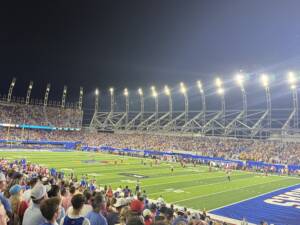
Missouri traveled well, with Tigers fans occupying a noticeable portion of the stadium. The crowd appeared to be approximately 75 percent Kansas supporters and 25 percent Missouri supporters, creating a charged environment throughout the night.
The experience was affected somewhat by the ongoing renovation of David Booth Kansas Memorial Stadium. The stadium is operating at reduced capacity during the second phase of construction, with the completed venue scheduled to open for the 2027 season. Once the work is finished, the new facility should provide Kansas with a dramatically improved game-day environment. KU Gateway District
Considering the history and regional appeal of the matchup, Arrowhead Stadium also remains a natural setting for future editions of the Border War. However, having the rivalry return to the campuses allows each fan base to experience it in its own environment.
By the fourth quarter, many Kansas fans had started leaving the stadium as disappointment set in. Leipold will face criticism after falling to 0–7 in rivalry games during his Kansas tenure, but the Jayhawks still have nearly their entire Big 12 schedule ahead of them.
Unfortunately for both fan bases, they will have to wait several years for another opportunity. The next Border War is scheduled for 2031 in Columbia, followed by another meeting in Lawrence in 2032. Missouri will hold bragging rights throughout the break.
Kansas will now travel to London to face Arizona State in the Union Jack Classic at Wembley Stadium on September 19. The game will serve as the Jayhawks’ Big 12 opener and an opportunity to respond on an international stage.
Missouri returns home to face Troy on September 19 before beginning the heart of its SEC schedule. Following the victory, the Tigers moved three spots to No. 20 in the latest AP Top 25. AP Top 25
The programs may be moving toward different conference goals, but Friday night demonstrated that the Border War still carries a meaning that extends beyond the standings. The rivalry’s history, intensity and regional pride remain alive.
Missouri walked away with another victory. Kansas walked away knowing it must wait until 2031 for its next chance at revenge.